Rab Cycle
Rab protein은 membrane과 cytosol 사이를 cycle하면서 vesicle transport를 조절한다.123 이 cycle은 vesicle과 target membrane에서 일어나며, vesicle identity와 targeting specificity를 제공한다.
Rab protein의 구조와 특성
Monomeric GTPase
- 60개 이상의 member (mammalian cell)
- Largest subfamily of monomeric GTPase
- 각 Rab이 specific organelle/vesicle에 associate
Membrane localization
각 Rab protein은 특정 compartment에 localize:34
| Rab protein | Organelle/Vesicle |
|---|---|
| Rab1 | ER, Golgi complex |
| Rab2 | cis Golgi network |
| Rab3A | Synaptic vesicle, secretory vesicle |
| Rab4/Rab11 | Recycling endosome |
| Rab5 | Early endosome, plasma membrane |
| Rab6 | Medial and trans Golgi |
| Rab7 | Late endosome |
| Rab8 | Cilia |
| Rab9 | Late endosome, TGN |
Basic Rab cycle
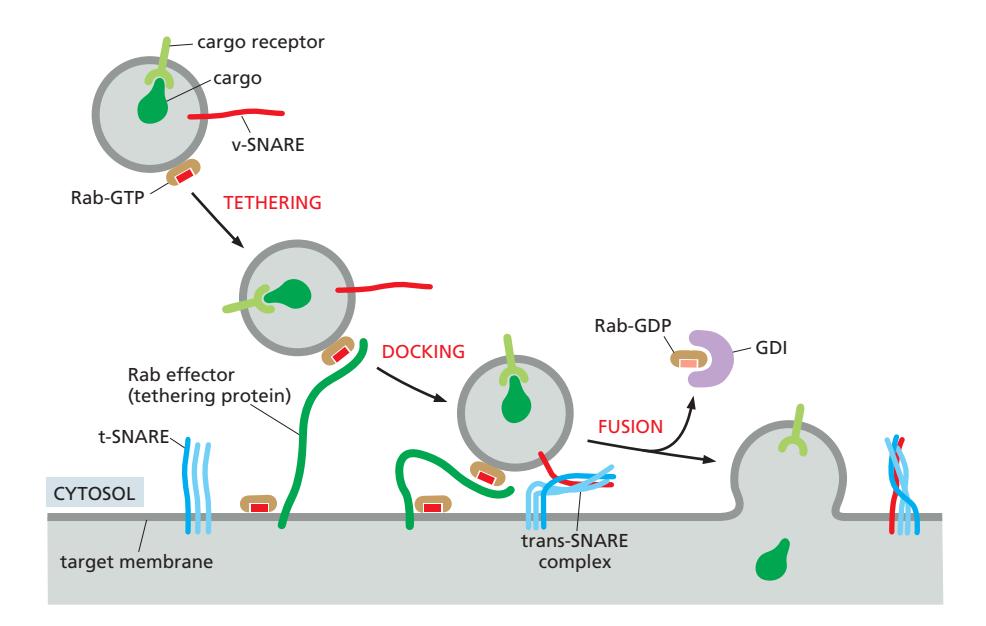
GDP-bound state (inactive, cytosolic)
Membrane recruitment and activation
Step 1: GEF binding
- Membrane-bound Rab GEF가 Rab-GDP에 binding
- 종종 coat component가 GEF recruit
Step 2: GDP → GTP exchange
- GEF가 GDP release 촉매
- GTP binding (high cytosolic concentration)
Step 3: Membrane insertion
- GTP binding으로 Conformational change
- Lipid anchor (prenyl group) exposure
- Membrane에 insert4
- GDI release
Active state (GTP-bound, membrane)
Rab effector recruitment
- Active Rab-GTP가 다양한 Rab effector에 binding
- Effector type:
- Tethering protein
- Motor protein
- Lipid-modifying enzyme
- SNARE-binding protein
- Scaffold protein
Inactivation and membrane release
Step 1: GAP activates Rab GTPase
- Rab GAP가 GTP hydrolysis 촉진4
- Often at target membrane
Step 2: GTP → GDP
- Conformational change
- Effector release
- Lipid anchor retraction
Step 3: GDI binding
Vesicle에서의 Rab activation
Initial activation
Transport vesicle 형성 시:
- Coat component가 specific Rab GEF recruit
- Rab activation
- Vesicle에 Rab-GTP display
Multiple consequences
Molecular marker
- Vesicle identity 표시
- Target membrane recognition에 사용
Motor protein recruitment
- Kinesin, dynein, myosin 등
- Microtubule/actin filament을 따라 이동
Tethering protein recruitment
- Long-range capture of vesicle
- Initial contact with target membrane
Target membrane에서의 Rab function
Rab-associated domain formation
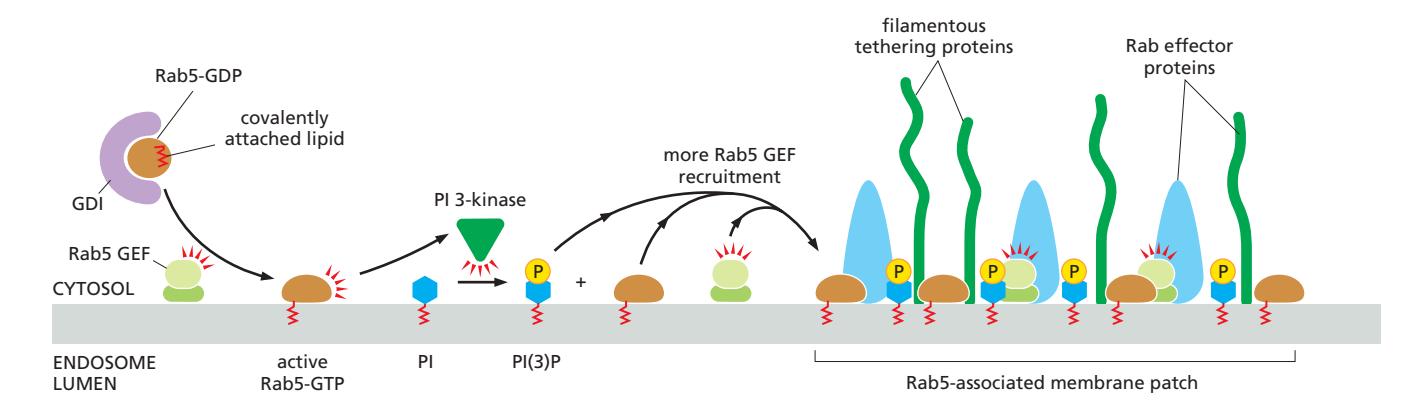
Positive feedback mechanism
- Rab GEF가 membrane에서 Rab activate
- Active Rab이 더 많은 같은 Rab GEF recruit
- More Rab activation
Rab5 예시:
- acitve Rab5가 PI 3-kinase activate → PI(3)P production5
- PI(3)P가 Rab effector (tethering protein 포함) binding stabilize5
- Rab-5 associated membrane patch 형성
Organelle identity 부여
Rab-associated domain이 organelle의 특성 결정:
- Incoming vesicle traffic (tethering protein, SNARE)
- Outgoing vesicle traffic (coat protein)
- Enzyme activity (lipid kinase, etc.)
- Positioning (motor protein)
Rab Cascades에 의해 Rab의 종류가 바뀌면서 소포의 성질도 시간에 따라 변화함.
- Rab5 (early endosome) → Rab7 (late endosome) 전환. Rab5 → Rab7 전환이 실패하면, cargo는 lysosome에 도달 불가
- lysosome과 fusion이 일어나려면 late endosome이 되어야 함. 즉 Rab7으로 전환이 필요
Vesicle tethering and docking
Long-range tethering
- Rab effector (filamentous protein)가 vesicle capture
- 200 nm까지 reach 가능
- Vesicle의 Rab-GTP와 target membrane의 Rab effector 상호작용. Rab effector는 target membrane의 Rab-GTP와도 상호작용. 여기서 두 Rab는 같은 종류여야함.4
SNARE-mediated docking
- Rab effector가 SNARE를 selective하게 binding
- v-SNARE와 t-SNARE pairing 촉진
- Membrane fusion 유도
Rab inactivation
- Fusion 후 Rab GAP가 Rab-GTP hydrolyze
- Rab-GDP가 membrane에서 dissociate
- GDI에 의해 cytosol로 return
생리적 중요성
Rab cycle의 dysregulation:
- Vesicle mis-targeting
- Organelle identity loss
- Trafficking defect
- Disease (e.g., Parkinson’s disease와 Rab7L1 mutation)
Footnotes
-
2021 중간 미상C번 — Rab effector(tethering protein, motor protein 등)의 역할이 선지 근거로 활용됨. ↩
-
2022 중간 25번 — Rab cycle에서 Rab-GTP가 effector를 모집하고 tethering protein이 vesicle을 target membrane으로 안내하는 과정이 정답 근거로 활용됨. ↩
-
2023 중간 7번 — ①: Rab GAP가 Rab-GTP의 hydrolysis능력을 활성화 하여 Rab-GDP로 만듦. 이것으로 소포에서 방출됨. 방출된 후에 GDI 결합✗- ②: Rab 종류는 Rab cascade에 의해 전환될 수 있음 (예: Rab5→Rab7 전환으로 early→late endosome 성숙) ✗- ③: 각 세포 소기관의 막에는 고유한 Rab 단백질이 존재 → “주소지(zip code)” 역할 ✗- ④: 소포와 target에 동일한 Rab-GTP가 존재하여 tethering에 관여 ✓- ⑤: Rab은 소포 안(lumen)이 아닌 막 표면(cytoplasmic side)에 결합 ✗ ↩ ↩2 ↩3 ↩4 ↩5 ↩6 ↩7 ↩8
-
2025 중간 19번 — ①번 선지: GAP에 의해 가수분해가 이루어져야 Rab 단백질이 활성화된다 (틀림, GAP는 GTP 가수분해로 Rab 비활성화, GEF가 GDP→GTP 교환으로 활성화); ②번 선지: Rab은 한번 활성화되면 하나의 소기관에만 위치하고 다른 곳으로 이동하지 않는다 (틀림, Rab cascade로 Rab5→Rab7 전환 등 소기관 정체성 변화); ③번 선지: Rab5 단백질이 시간이 지남에 따라 정체성이 변화되어 Rab7 단백질이 된다 (틀림, 동일 단백질이 전환되는 것이 아니라 다른 Rab 단백질로 교체); ④번 선지: Rab 단백질은 적어도 특정 Rab이 vesicle에 존재해야 target membrane에 있는 Rab이 활성화되어야 한다 (맞음, Rab effector가 target membrane의 tethering에 관여하며 특정 Rab 조합 필요, 정답); ⑤번 선지: Rab 단백질은 세포질(cytosol)에 soluble 상태로 존재하다가 특정 GEF에 의해 vesicle의 내부(lumen)쪽으로 결합된다 (틀림, Rab은 cytoplasmic face에 결합). ↩ ↩2 ↩3 ↩4 ↩5 ↩6
-
2025 중간 18번 — ④번 선지: Rab5가 PI3K를 활성화시켜 정확한 위치의 vesicle이 fusion될 수 있게 한다 (맞음, Rab5-GTP가 PI 3-kinase를 activate → PI(3)P 생성 → tethering protein 안정화 → early endosome fusion 촉진). ↩ ↩2