SNARE Cycle
1. Trans-SNARE Complex Formation
Location: Vesicle과 target membrane 사이 Function: Membrane fusion 촉진 State: Four-helix bundle across two membranes
2. Membrane Fusion
Trans-SNARE complex가 membrane fusion drive:
- Membrane apposition
- Lipid mixing
- Content release
3. Cis-SNARE Complex(언급 안 됨)
Fusion 후:
- Trans-SNARE complex → cis-SNARE complex
- 모든 SNARE가 같은 membrane에 위치
- 여전히 매우 stable
4. NSF-mediated Disassembly
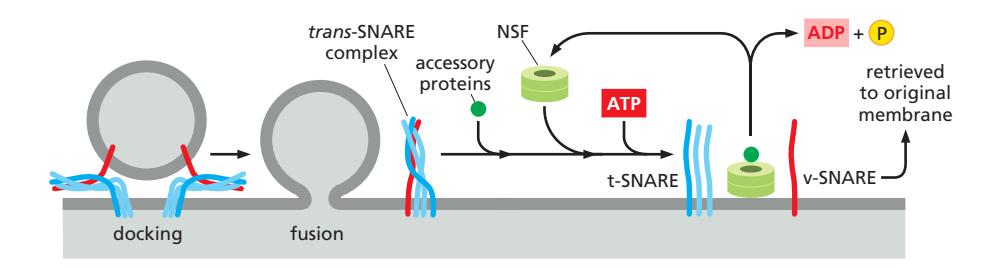 NSF (N-ethylmaleimide-sensitive fusion protein):
- Hexameric AAA-ATPase = Unfoldase
- Cis-SNARE complex 인식 Mechanism:
- NSF가 accessory protein (α-SNAP)과 함께 cis-SNARE complex 결합12
- ATP hydrolysis12
- Conformational change
- SNARE helix를 forcibly unwind12
- SNARE protein 분리12
5. SNARE Recycling
분리된 SNARE는:
Footnotes
-
2023 중간 8번 — ①번 선지: Lipid bilayer 두 막의 세포질 면에서 만들어진 막에 새로운 bilayer가 만들어진다 (맞음, v-SNARE와 t-SNARE의 trans-SNARE complex가 membrane apposition·lipid merger를 drive, 정답); ②번 선지: 융합에 관한 SNARE 복합체(V-&T-SNARE)는 분리 후 그대로 보존된다 (틀림, NSF/α-SNAP에 의해 cis-SNARE complex가 disassembly된 후 재활용); ③번 선지: Hemifusion 단계에서 합쳐지는 bilayer의 한 층이 남아 필요 없어지면 분리된다 (틀림, hemifusion 단계에서 두 막의 outer leaflet만 먼저 fusion); ④번 선지: Stalk 형성 단계에서 lipid bilayer 두 막의 세포질 면의 인지질이 섞여 stalk를 만든다 (맞음, cytoplasmic face의 outer leaflet이 stalk 형성); ⑤번 선지: 소포와 target 막사이의 작동자가 먼저 연결될 때만 SNARE가 pairing 할 수 있다 (틀림, SNARE pairing 자체가 fusion을 drive하며 tethering 후에 가능). ↩ ↩2 ↩3 ↩4 ↩5 ↩6 ↩7
-
2025 중간 24번 — ①번 선지: 세포질 면의 막에서의 인지질이 초기 stalk를 만든다 (맞음, cytoplasmic face/outer leaflet의 인지질이 먼저 stalk 형성, 정답); ②번 선지: 세포질쪽에서 만들어진 막에 새로운 bilayer가 만들어진다 (틀림, 새 bilayer는 lumen 쪽에 형성); ③번 선지: Hemifusion 단계에서 합쳐지는 bilayer의 lumenal 막은 융합되지 않고 diaphragm이 형성된다 (맞음, hemifusion에서는 outer leaflet만 융합, inner/lumenal leaflet이 hemifusion diaphragm 형성); ④번 선지: 융합에 관한 SNARE 복합체 (V-&T-SNARE)는 분리되지 않고 보존된다 (틀림, NSF에 의해 분리 후 재활용); ⑤번 선지: Hemifusion 단계에서 합쳐지는 bilayer의 rupture를 통해 pore가 만들어지고 세포질 내에서 소포의 내용물이 희석된다 (틀림, pore 형성 후 내용물은 target compartment lumen으로 방출). ↩ ↩2 ↩3 ↩4 ↩5 ↩6 ↩7