Citric Acid Cycle
개요
Citric Acid Cycle (TCA cycle, Krebs cycle)은 미토콘드리아 matrix에서 Acetyl CoA를 완전히 산화하여 NADH, FADH₂, GTP, CO₂를 생성하는 순환 대사 경로이다.123456
“The oxidation of acetyl CoA is carried out by the citric acid cycle, also called the Krebs cycle. This cycle produces CO₂ and more important saves a great deal of the bond energy released by this oxidation in the form of NADH.” — Chapter 14
위치: 미토콘드리아 matrix
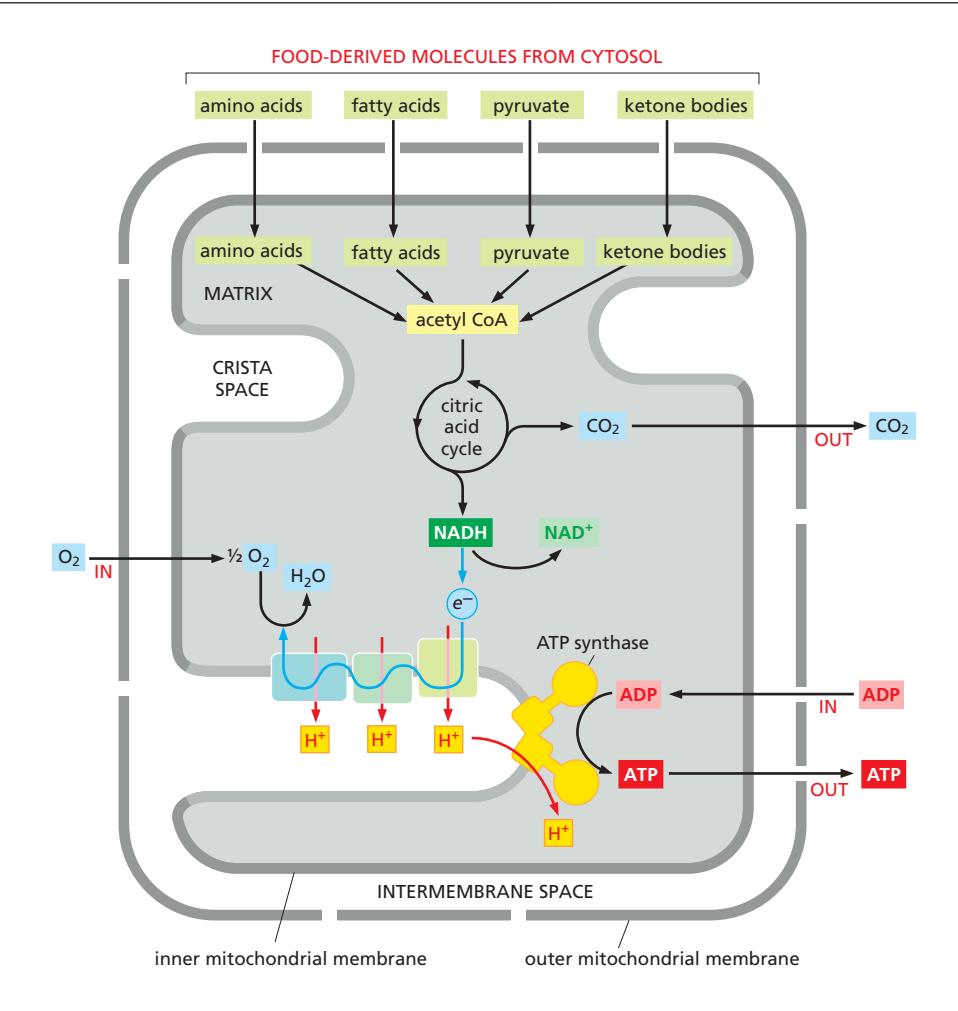 Figure 14-10: 미토콘드리아에서의 에너지 변환 대사 요약.
8단계 반응 개요
| Step | 효소 | Reactant | Product |
|---|---|---|---|
| 1 | Citrate synthase | Acetyl CoA + OAA | Citrate |
| 2 | Aconitase | Citrate | Isocitrate |
| 3 | Isocitrate dehydrogenase | Isocitrate | α-Ketoglutarate + CO₂ + NADH |
| 4 | α-Ketoglutarate dehydrogenase | α-Ketoglutarate | Succinyl CoA + CO₂ + NADH |
| 5 | Succinyl CoA synthetase | Succinyl CoA | Succinate + GTP |
| 6 | Succinate dehydrogenase | Succinate | Fumarate + FADH₂ |
| 7 | Fumarase | Fumarate | Malate |
| 8 | Malate dehydrogenase | Malate | Oxaloacetate + NADH |
Net Products (Acetyl CoA 1분자, 1 turn 기준)
| 분자 | 수량 |
|---|---|
| NADH | 3 (Step 3, 4, 8) |
| FADH₂ | 1 (Step 6) |
| GTP | 1 (Step 5) |
| CO₂ | 2 |
교과서 Table 14-3:
“2 acetyl CoA → 6 NADH + 2 FADH₂ + 2 GTP” (2 turns for 1 glucose)
특이점: Succinate Dehydrogenase
Step 6의 succinate dehydrogenase는 미토콘드리아 inner membrane에 embedded 되어 있으며, ETC의 Complex II로도 기능한다.
“There is an unusual additional respiratory chain complex that is an important component of the citric acid cycle, where it is known as succinate dehydrogenase.” — Chapter 14
→ Complex II (Succinate dehydrogenase)
조절
| 효소 | 억제 | 활성화 |
|---|---|---|
| Citrate synthase | NADH, Succinyl CoA, Citrate, ATP | |
| Isocitrate dehydrogenase | NADH, ATP | ADP |
| α-KG dehydrogenase | NADH, Succinyl CoA |
관련 개념
Footnotes
-
2022 기말 3번 — TCA cycle 중간체(α-KG, Succinate, Fumarate, Malate, OAA) 발생 순서 문항. 선지 미복기. ↩
-
2023 기말 5번 — TCA cycle 중간체 작용 순서(α-ketoglutarate→succinate→malate = C→B→A)가 정답 ⑤의 근거로 활용됨. ↩
-
2023 기말 6번 — TCA cycle 효소 작용 순서(Aconitase→Succinate dehydrogenase→Fumarase = C→B→A)가 정답 ⑤의 근거로 활용됨. ↩
-
2023 기말 7번 — TCA cycle 2회전에서 총 NADH 6개 생성(3 NADH/turn × 2), pyruvate oxidation 2 NADH, glycolysis 2 NADH → 총 10 NADH가 정답 ④의 근거로 활용됨. ↩
-
2023 기말 10번 — Caprylic acid(C8)의 β-oxidation 산물 4 acetyl-CoA가 TCA cycle 4회전을 거치며 NADH 12개가 생성된다는 내용이 정답 근거로 활용됨. ↩
-
2025 기말 1번 — ③번 선지: TCA cycle 반응 자체에 O₂가 직접 참여하는 단계는 없음(O₂는 ETC Complex IV에서만 사용됨) → “TCA cycle이 O₂가 없으면 회로 자체가 중단된다”는 틀린 설명. ↩