Biomolecular Condensates (생체분자응집체)
개요
- 막(membrane) 없이 형성되는 기능적 구획
- 특정 분자들이 모여 농축된 영역 형성
- ==Compartment = 반드시 membrane이 필요한 것은 아님
형성 메커니즘: Multivalent Interactions
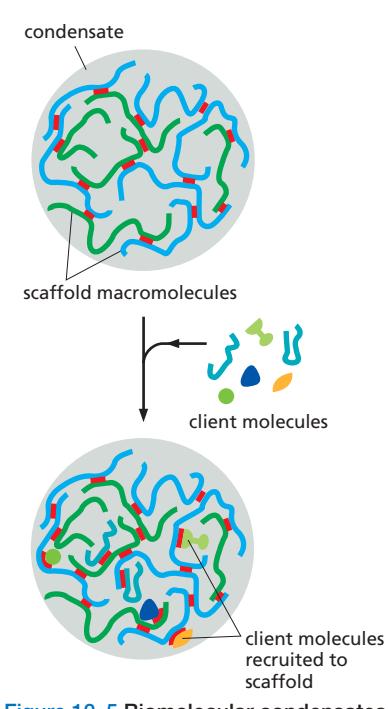 Multivalent interaction: 하나의 분자가 여러 개의 결합 부위를 보유 → 동시에 여러 분자와 결합
→ 네트워크 형성 → 액체처럼 분리 (phase separation)
Multivalent interaction: 하나의 분자가 여러 개의 결합 부위를 보유 → 동시에 여러 분자와 결합
→ 네트워크 형성 → 액체처럼 분리 (phase separation)
Scaffold
- 응집체 구조를 직접 형성하는 macromolecules (proteins, RNAs)
- 응집체 형성의 주체
Client
- Scaffold와의 특이적 상호작용에 의해 선택적으로 모집(recruit)됨
- 응집체 형성은 client 없이도 가능 (client 모집이 응집체 형성의 전제 조건이 아님)1
특성
- 막 없이도 compartmentalization 가능
- 반응속도 조절 가능
- 동적으로 형성·해체 가능 (cellular need에 반응)
예시: Nucleolus
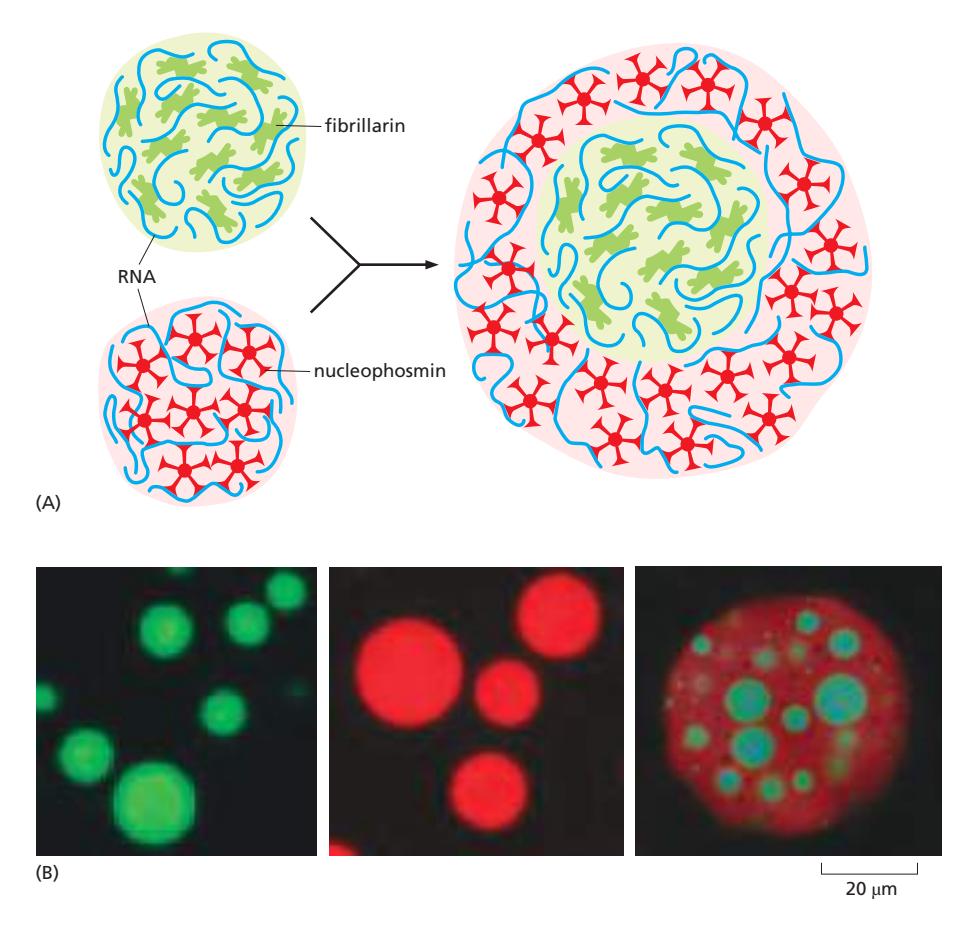 Nucleolus는 대표적인 biomolecular condensate이다.
- Fibrillarin (fibrillar component) + RNA → 독립적인 condensate 형성
- Nucleophosmin (granular component) + RNA → 또 다른 condensate 형성
- 함께 혼합 시 → Multilayered condensate: 하나의 구조 안에 서로 다른 condensate 공존
- Core: fibrillarin-rich layer
- Outer layer: nucleophosmin-rich layer
- 반응을 공간적으로 분리 → 서로 다른 기능을 동시에 수행
예시; 진핵생물에서의 Biomolecular Condensates
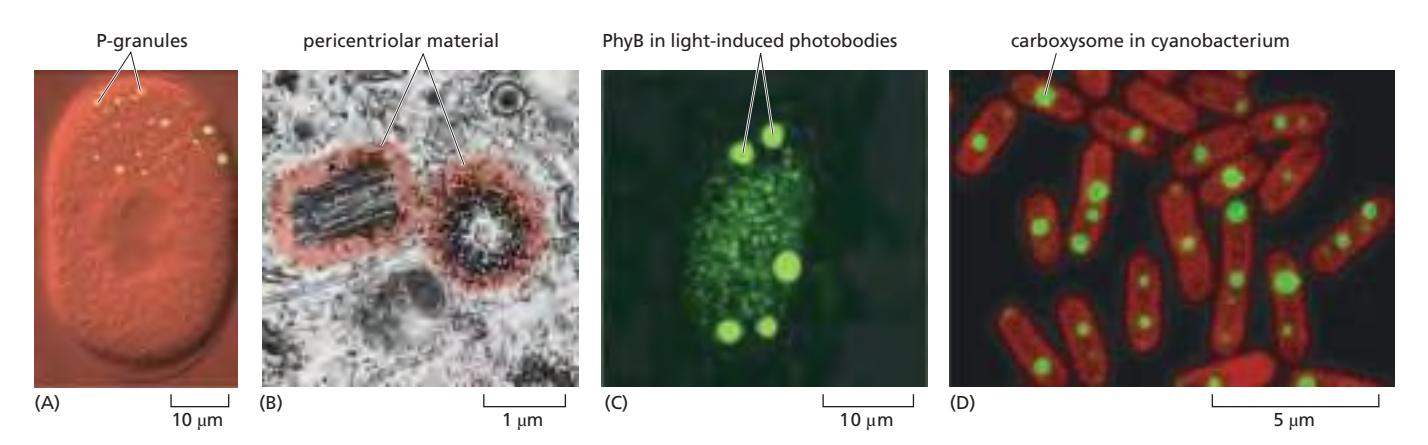 강의노트에 나온 사진은 맨 왼쪽 P-granules.
| TABLE 12–3 Examples of Eukaryotic Biomolecular Condensates | ||
|---|---|---|
| Biomolecular condensate | Location | Proposed associated function(s) |
| Nucleolus | Nucleus | rRNA transcription and ribosome assembly |
| Pyrenoid | Chloroplast | Carbon fixation from CO2 in algae |
| Stress granules | Cytosol | Temporary storage, particularly of translation-related components |
| P-granules | Cytosol | RNA metabolism and inheritance |
| Balbiani body | Cytosol | Localization and inheritance of mRNAs and organelles |
| Cajal body | Nucleus | mRNA processing |
| Paraspeckles | Nucleus | Regulation of gene expression |
| RNA transport granule | Neuron | RNA localization to subcellular locations in development and in neurons |
| PML body | Nucleus | Storage of nuclear factors; regulation of gene expression |
| Postsynaptic density | Dendrite | Organization of macromolecules needed for neuronal transmission |
Phosphorylation에 의한 동적 조절==
신호전달 과정에서 condensate는 필요에 따라 형성되고 해체된다:
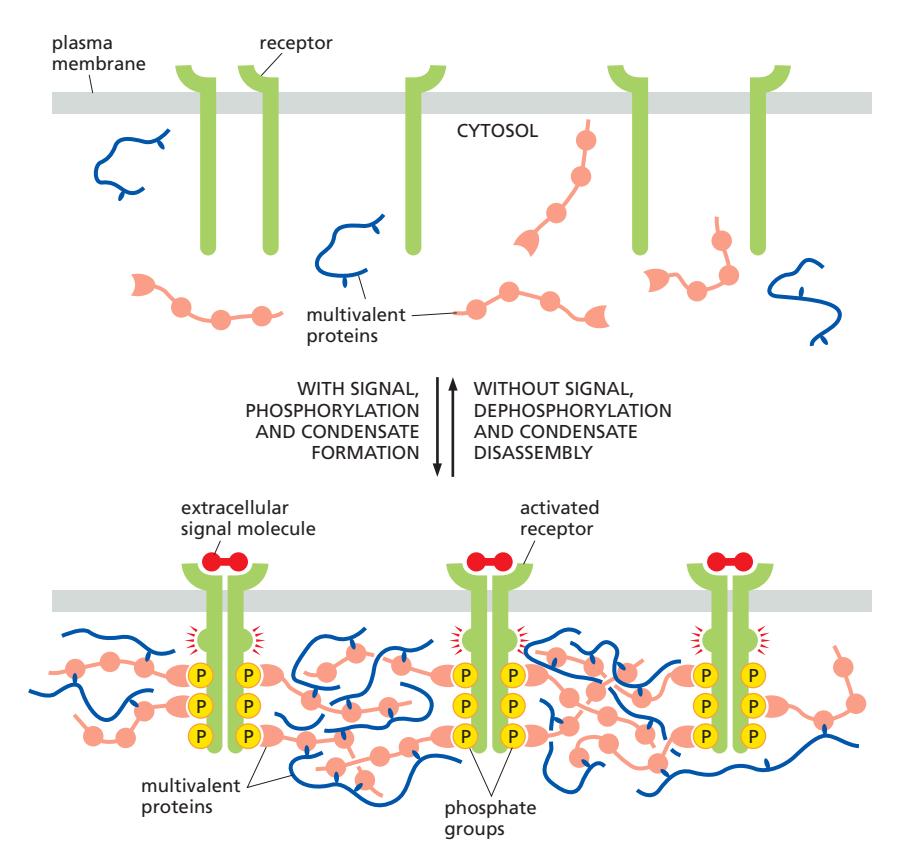
| 단계 | 내용 |
|---|---|
| 1. Trigger | Ligand가 receptor에 결합 → receptor 활성화 |
| 2. Phosphorylation | Receptor’s cytosolic tail 인산화 → docking site 생성 |
| 3. Condensate formation | Multivalent protein들이 동시에 결합 → 네트워크 형성 (Signal Hub) |
| 4. Signal amplification | 효소와 기질이 한 곳에 집중 → 반응속도 증가 → 신호 증폭 |
| 5. Disassembly | Dephosphorylation → 결합 부위 소멸 → condensate 붕괴 → 신호 종료 |
의의
- 세포가 막 없이도 compartmentalization 가능함을 보여주는 원리
- 필요에 따라 동적으로 형성·해체 → 세포 반응 속도 및 조절 효율 향상
- Phase separation 기반의 새로운 세포 조직화 원리
관련 개념
Footnotes
-
2025 중간 17번 — condensate는 막이 없는 membraneless organelle(선지 ① 틀림), client는 condensate 형성에 필수가 아님(선지 ⑤ 틀림)이 출제됨. ↩