Retrieval Pathway to the ER
개요
Retrieval pathway는 ER을 실수로 떠난 protein을 다시 ER로 되돌리는 transport system이다.123 이 pathway는 각 compartment의 identity를 유지하는 데 essential하다.
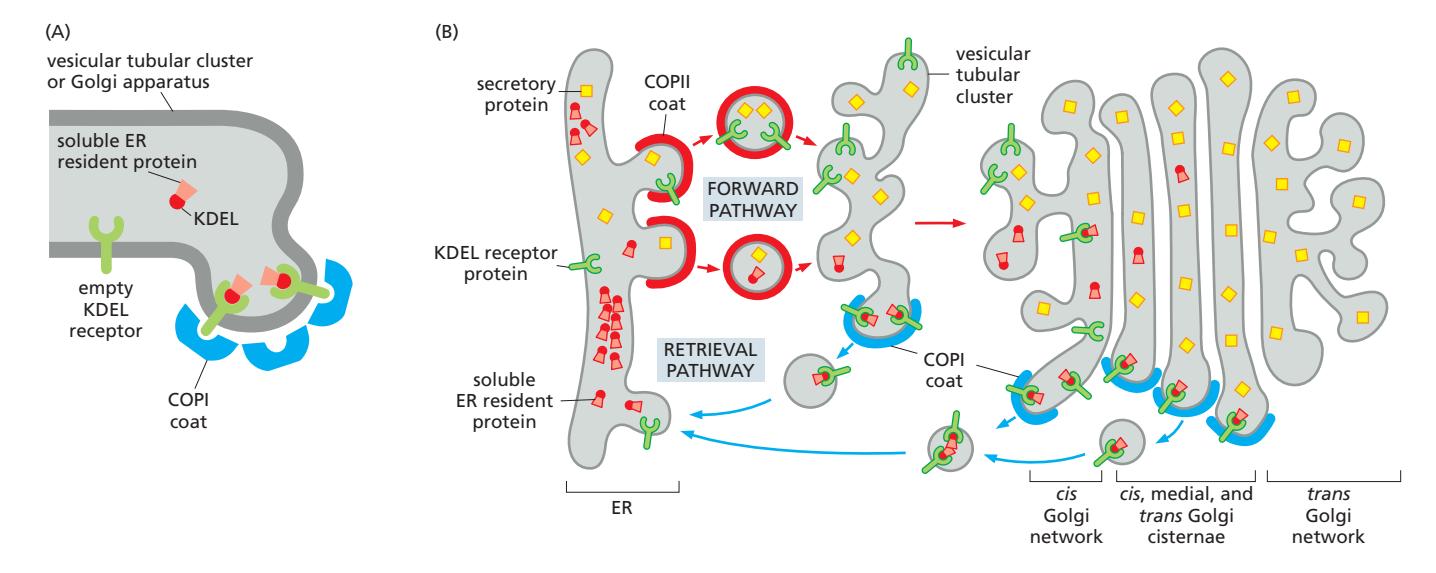
COPI-coated Vesicle
Retrieval pathway는 COPI-coated vesicle에 의해 매개된다.345
Budding Sites
COPI vesicle budding 발생 위치:
- Vesicular tubular cluster: ER vesicle fusion 직후 시작
- Golgi cisternae: 각 cisterna에서 budding
- cis Golgi network: 주요 retrieval site
- trans Golgi network: 일부 protein return
Cargo
COPI vesicle이 운반하는 cargo:
-
Escaped ER resident protein
- Soluble ER protein
- ER membrane protein
-
Recycled machinery
- Cargo receptor
- SNARE protein
- Coat component
-
Golgi resident protein
- 다음 cisterna로 잘못 이동한 경우
- Appropriate cisterna로 return
Signals
Retrieval pathway는 specific signal에 의존한다.
Membrane Protein Signal: KKXX
=ER resident membrane protein34 Structure:
- C-terminal end에 위치
- K-K-X-X: Two lysine + any two amino acid
Mechanism:
- KKXX sequence가 COPI coat에 directly bind34
- Protein이 COPI-coated vesicle에 package
- ER로 retrograde delivery
- ER에 도달하여 release
Protein examples:
- ER membrane protein
- v-SNARE와 t-SNARE (ER-Golgi interface에서 기능)
- Some cargo receptor
Soluble ER resident Protein Signal: KDEL
Structure:
Protein examples:
- BiP (ER chaperone)
- Other soluble ER resident protein
Genetic engineering evidence:
- KDEL 제거: Protein slowly secreted
- KDEL 추가: Normally secreted protein이 ER accumulate
KDEL Receptor
Soluble protein의 retrieval은 KDEL receptor 필요.
Structure
- Multipass transmembrane protein
- Luminal domain: KDEL sequence 인식34
- Cytosolic domain: COPI coat binding34
Cycling Mechanism
ER → Golgi:
Golgi에서:
- KDEL-bearing protein 인식
- Receptor–ligand complex 형성
- COPI coat recruitment
- COPI vesicle에 package
Golgi → ER:
- COPI vesicle이 ER로 이동
- ER에 fusion
- Higher pH in ER
- Ligand release
- Free receptor는 다시 Golgi로
pH-dependent Affinity
Key feature:
Molecular basis:
- Critical histidine in KDEL receptor
- Golgi의 lower pH에서 protonated4
- Protonation이 KDEL sequence와의 interaction favor4
- ER의 higher pH에서 deprotonated → weak binding4
Functional consequence:
- Directional transport
- Unidirectional retrieval
- Efficient cycling
관련 내용
- ER to Golgi transport
- Vesicular tubular cluster formation
- COPI vesicle formation
- Golgi apparatus
- ER resident proteins
- Chaperone proteins
Footnotes
-
2021 중간 미상B번 — KDEL(soluble ER 단백질 회수)과 KKXX(막 단백질 회수) 신호를 이용한 ER retrieval pathway 개념이 선지 근거로 활용됨. ↩
-
2022 중간 27번 — COPI vesicle을 통한 ER retrieval 메커니즘과 KDEL receptor의 pH 의존적 결합이 정답 근거로 활용됨. ↩
-
2023 중간 5번 — ①번 선지: KDEL 신호서열은 COPI에 의해 운반된다 (틀림, KDEL 자체가 COPI에 결합하는 것이 아니라 KDEL receptor의 cytosolic tail에 있는 신호(KKXX-like)가 COPI에 결합); ②번 선지: ER 루멘은 골지체에서의 루멘과 비교하여 더 낮은 pH를 가지고 있다 (틀림, ER lumen pH ~7.2 > Golgi pH ~6.5); ③번 선지: ER로의 회수 과정에는 COPII가 coating 단백질로 작용한다 (틀림, ER retrieval은 COPI vesicle 사용, COPII는 ER→Golgi 전진 수송); ④번 선지: Soluble ER resident 단백질은 KKXX 신호서열을 가지고 있다 (틀림, soluble lumenal ER resident는 KDEL, 막 단백질이 KKXX 신호 보유); ⑤번 선지: KDEL receptor는 ER의 vesicle 그리고 골지체에 모두 위치한다 (맞음, KDEL receptor는 ER과 Golgi 사이를 순환, 정답). ↩ ↩2 ↩3 ↩4 ↩5 ↩6 ↩7 ↩8 ↩9 ↩10 ↩11
-
2025 중간 20번 — ①번 선지: KDEL 신호서열은 COPI 결합 신호이다 (틀림, KDEL은 KDEL receptor가 인식하는 신호, receptor의 KKXX-like tail이 COPI 결합); ②번 선지: ER로의 회수 과정에는 COPII가 coating 단백질로 작용한다 (틀림, COPI 사용); ③번 선지: KDEL receptor는 대부분 활성화되어 불활성화되지 않고 이동된다 (틀림, KDEL receptor는 재활용(recycled) 됨); ④번 선지: Soluble ER resident 단백질은 KKXX 신호서열을 가지고 있다 (틀림, KKXX는 transmembrane ER membrane 단백질의 신호, soluble은 KDEL); ⑤번 선지: ER 루멘은 골지체에서의 루멘과 비교하여 더 높은 pH를 가지고 있어 KDEL receptor가 cargo와 분리된다 (맞음, ER pH ~7.2에서 KDEL receptor가 KDEL 배위체를 낮은 친화도로 결합하여 cargo 방출, 정답). ↩ ↩2 ↩3 ↩4 ↩5 ↩6 ↩7 ↩8 ↩9 ↩10 ↩11
-
2025 중간 18번 — ⑤번 선지: COPI 코팅이 활성화되어 retrieval pathway(역행 수송)가 활성화되고 유지된다 (틀림, COPI는 PI(4)P/ARF에 의해 Golgi에서 활성화되며, 제시된 효소들은 PI(4,5)P₂를 분해하여 COPI와는 관련 없음). ↩