Transportation Mechanism_MOC
개요
Transport vesicle이 donor compartment에서 budding된 후, target membrane으로 이동하여 fusion하기까지의 과정은 정교하게 조절된다. 이 과정은 vesicle의 coat disassembly, vesicle의 directed movement, 그리고 correct target membrane에서의 selective docking과 fusion을 포함한다.1
Transportation의 핵심 요소
Transport vesicle의 이동과 targeting은 다음 molecular system에 의해 조절된다:
1. Coat-recruitment GTPase
- Coat assembly 개시
- Coat disassembly timing 조절
- Vesicle formation의 critical switch point 제공
2. Rab Protein System
- Vesicle과 target membrane에 특이적 marker 제공
- GTP/GDP cycle을 통한 membrane association 조절
- Multiple Rab protein간의 sequential activation으로 organelle maturation
3. Motor Protein
- Cytoskeleton을 따라 vesicle 이동
- Rab effector로 작용
- Microtubule 또는 actin filament 이용
4. Tethering Protein
- Initial capture of vesicle at target membrane
- Long-range interaction (최대 200 nm)
- Rab effector로 작용
Monomeric GTPase control of Coat Assembly
Coat assembly와 disassembly는 coat-recruitment GTPase에 의해 조절된다.
GTPase Family
세 가지 주요 coat-recruitment GTPase:
- Sar1: COPII coat assembly (ER membrane)
- ARF protein: COPI coat과 clathrin coat assembly (Golgi membrane)
- Rab7: Retromer coat assembly (endosome membrane)
Molecular Switch Mechanism
이들은 monomeric GTPase로서 작동:
Inactive state (GDP-bound):
- Cytosol에 high concentration으로 존재
- Soluble form
Active state (GTP-bound):
- Membrane에 anchored
- Coat protein recruitment
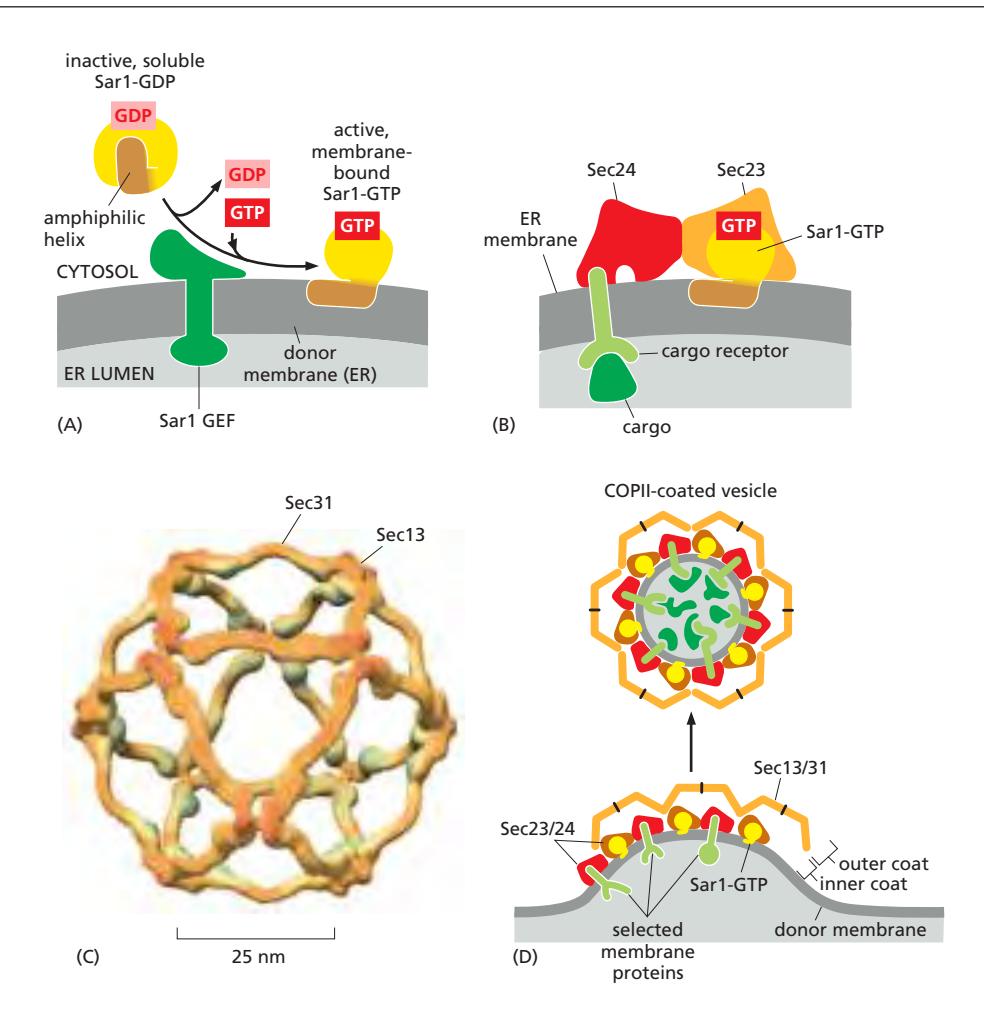
Activation Cycle
-
Activation:
- ER membrane의 Sar1 GEF가 cytosolic Sar1-GDP 인식
- GDP release → GTP binding
- Sar1-GTP는 amphiphilic helix expose
- Helix가 ER membrane의 cytoplasmic leaflet에 insert
-
Coat Recruitment:
- Membrane-bound Sar1-GTP가 COPII adaptor protein (Sec23/Sec24) recruit
- Inner coat layer 형성
- Sec23/Sec24가 cargo receptor binding site 보유
- Outer coat protein (Sec13/Sec31) recruitment
- Coat가 membrane deformation과 bud formation drive
-
Disassembly:
- Fully assembled COPII coat가 Sar1의 GTPase activity accelerate
- GTP → GDP hydrolysis
- Sar1-GDP는 membrane에서 dissociate
- Coat disassembly
Timing Control
Key principle: Vesicle formation이 GTP hydrolysis보다 빠르게 완료되어야 함
- Bud formation이 충분히 빠르면 complete vesicle 생성
- 느리면 premature disassembly로 실패
- 적절한 시간과 장소에서 vesicle formation 보장
COPI Coat의 특수한 조절
COPI-coated vesicle은 다른 disassembly trigger 사용:
Curvature sensing:
- ARF GAP가 assembling COPI coat에 recruit
- Membrane의 lipid packing density sensing
- Curvature가 vesicle 수준 접근 시 ARF GAP 활성화
- ARF의 GTP hydrolysis 자극 → coat disassembly
Rab Cascades
Rab cascade는 하나의 Rab protein이 다른 Rab protein을 순차적으로 recruit하고 활성화하는 과정이다.
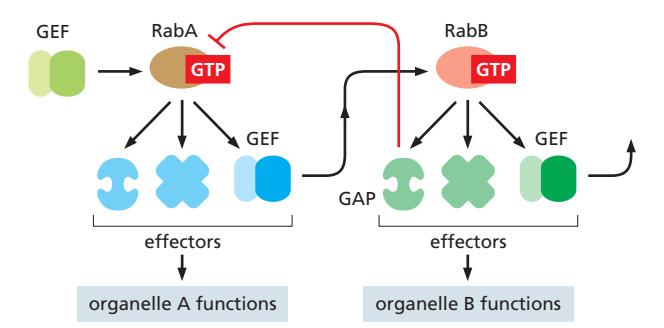
Mechanism
-
Initial Rab activation (RabA):
- RabA GEF가 locally activated
- RabA-GTP가 membrane에 insert
- RabA-associated membrane patch (Rab domain) 형성
-
Effector recruitment:
- Active RabA가 effector protein recruit
- 중요한 effector 중 하나: RabB GEF
-
Next Rab recruitment (RabB):
- RabB GEF가 RabB recruit 및 activate
- RabB-GTP가 자신의 effector recruit
- RabB effector 중 하나: RabA GAP
-
Previous Rab inactivation:
- RabA GAP가 RabA-GTP hydrolysis 촉진
- RabA 비활성화 및 RabA-associated patch disassembly
- RabB-associated patch 성장
Functional Significance
Endosome maturation 예시:
- Rab5 (early endosome marker) → Rab7 (late endosome marker)
- Rab5-associated patch가 Rab7-associated patch로 대체
- Early endosome이 late endosome으로 conversion
특징:
- Unidirectional: Self-amplifying nature로 irreversible
- Progressive: Organelle identity의 ordered change
- Autonomous: Once initiated, proceeds automatically
Multiple Rab Cascade
일부 organelle은 multiple Rab cascade 거침:
- Each step이 organelle의 progressive maturation 나타냄
- Sequential functional reprogramming
Rab Cycle
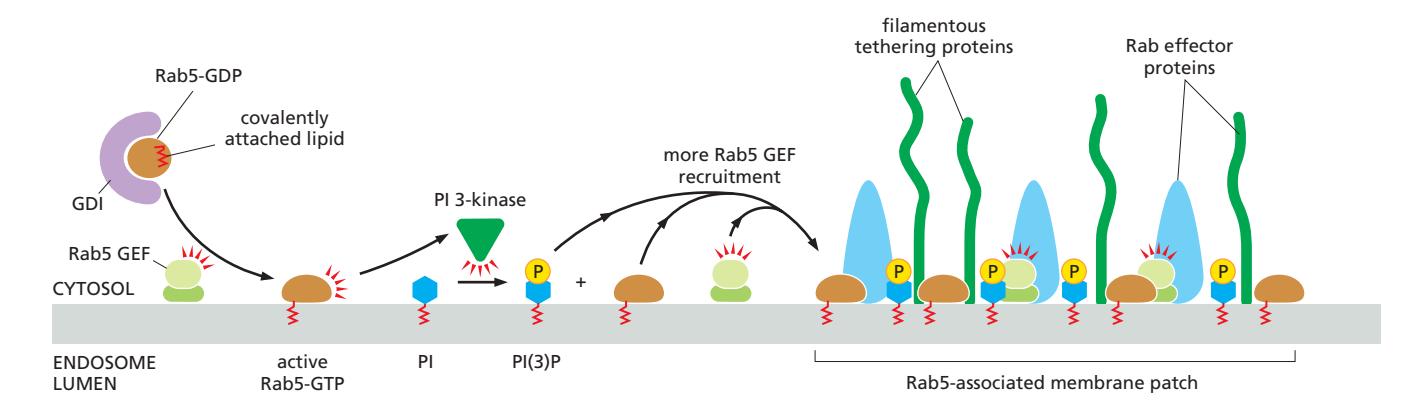
Rab protein은 GTP/GDP cycle과 membrane/cytosol cycle을 coupling하여 작동한다.
Rab Protein의 특징
Family:
- Monomeric GTPase superfamily의 largest subfamily
- Mammalian cell에 60개 이상 member
- 각 Rab는 특정 organelle 또는 transport vesicle과 연관
Distribution:
- 각 membrane-enclosed organelle에 최소 한 가지 Rab
- 각 Rab는 여러 compartment에 존재 가능
- Transport vesicle type에 따라 다른 Rab
Membrane–Cytosol Cycle
Inactive state (GDP-bound):
- Rab-GDP는 cytosol에서 soluble
- GDP dissociation inhibitor (GDI) protein과 결합
- GDI가 Rab를 soluble하게 유지
Activation:
- Membrane-bound Rab GEF가 Rab-GDP 인식
- GDP → GTP exchange 촉진
- Rab-GTP의 lipid anchor가 membrane insert
- GDI release
Active state (GTP-bound):
- Membrane-anchored Rab-GTP
- Rab effector protein recruit
Inactivation:
- Rab GAP가 GTP hydrolysis 촉진
- Rab-GDP 형성
- Membrane에서 dissociate
- GDI와 결합하여 cytosol로 return
Rab Effector
Rab effector는 diverse set of protein:
종류:
- Motor protein: Vesicle을 cytoskeleton을 따라 transport
- Tethering protein: Vesicle과 target membrane 연결
- PI kinase: Local phosphoinositide 생성
- SNARE: Membrane fusion 매개
- Other Rab GEF: Rab Cascades 매개
Functional role:
- Vesicle의 correct target membrane으로의 delivery
- Membrane fusion preparation
- Organelle identity 정의
Organelle Identity
Rab protein은 organelle identity의 key determinant:
Rab-associated membrane patch:
- Specific Rab GEF가 localized activation
- Active Rab protein이 자신의 effector recruit
- Effector 중에는 PI kinase 포함 → local PIP 생성
- PIP와 Rab가 함께 effector stabilization
- Positive feedback로 patch assembly amplification
특징:
- Large, specialized membrane patch 형성
- Functionally distinct membrane domain 정의
- Multiple Rab-associated patch가 같은 organelle에 공존 가능
- 예: Endosome의 Rab5 (incoming vesicle), Rab11/Rab4 (recycling), Rab7 (lysosome로의 progression)
Transport Vesicle Guidance
Motor Protein
Rab effector로서의 motor protein:
- Vesicle을 microtubule 또는 actin filament를 따라 propel
- Long-distance transport 가능
- Direction 조절 (plus-end vs minus-end)
Tethering Protein
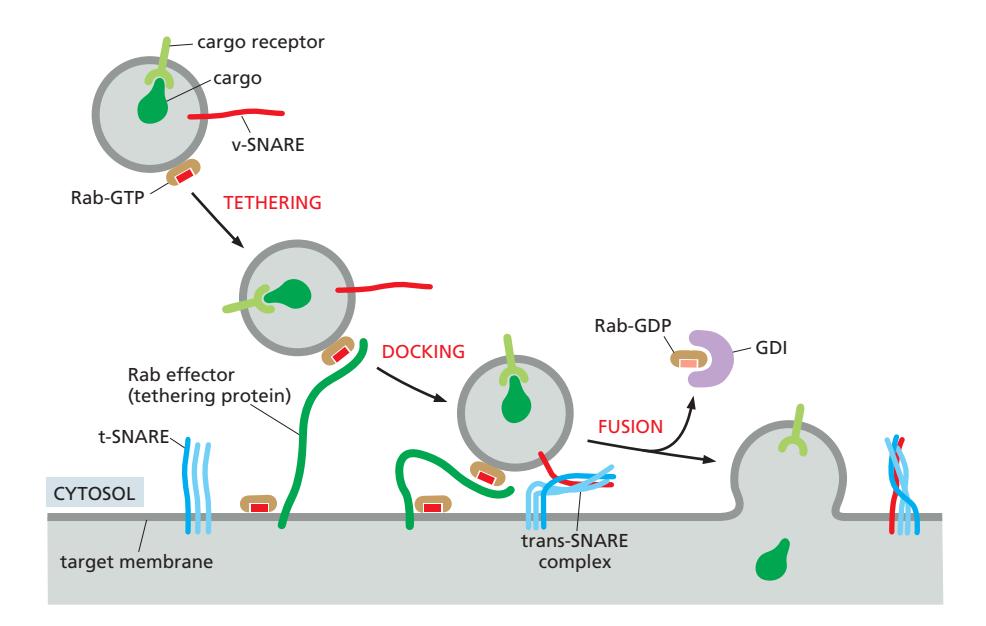
기능:
- Target membrane에 localized
- Active Rab protein 인식
- Long threadlike domain으로 vesicle capture (최대 200 nm)
Mechanism:
- Vesicle의 Rab-GTP가 tethering protein의 Rab effector domain 인식
- Tethering protein이 vesicle과 target membrane 연결
- Vesicle이 target membrane에 근접
- SNARE interaction 가능하게 됨
관련 내용
- Vesicle formation
- Vesicle fusion
- Phosphoinositide regulation
- Endosome maturation
- ER to Golgi transport
Footnotes
-
2023 중간 7번 — Rab protein의 GTP/GDP cycle과 membrane association을 통한 vesicle targeting 메커니즘이 정답 근거로 활용됨. ↩