Transportation from the ER Through the Golgi Apparatus_MOC
개요
ER에서 합성된 단백질은 Golgi apparatus를 거쳐 최종 목적지로 이동한다. 이 과정은 vesicular transport와 retrieval pathway의 정교한 균형으로 이루어지며, 각 compartment의 identity를 유지하면서도 지속적인 cargo 이동을 가능하게 한다.1
ER Exit: COPII-coated Vesicle Formation
ER Exit Site
단백질은 ER의 specialized region인 ER exit site에서 출발한다:
- Membrane에 bound ribosome 부재
- 대부분의 animal cell은 ER network 전체에 exit site 분산
- COPII coat assembly가 이곳에서 발생
Quality Control: CFTR
Protein folding 검증:
- 제대로 fold되고 assemble된 protein만 ER exit 가능
- Misfolded 또는 incompletely assembled protein은 transient하게 ER 체류
- Chaperone protein (BiP, calnexin)이 exit signal cover 또는 ER anchor
실패한 protein의 운명:
- ERAD를 통해 Cytosol로 transport back
- Proteasome에 의해 degradation
- Quality-control step으로 비정상 protein의 onward transport 방지
CFTR 예시:
- Cystic fibrosis transmembrane conductance regulator
- Plasma membrane의 Cl⁻ transporter
- Predominant mutation으로 slightly misfolded CFTR 생성
- Plasma membrane 도달하면 거의 정상 기능
- 하지만 ER에 retain되어 proteasome에서 degraded
- 결과: Cystic fibrosis disease
Exit Rate Variation
서로 다른 cargo protein은 다른 rate와 efficiency로 vesicle 진입:
- Folding과 oligomerization efficiency 차이
- Oligomerization kinetics 차이
- Cargo receptor와 COPII coat engagement 능력 차이
ER exit step은 secretory pathway의 major checkpoint.
Vesicular Tubular Cluster
Formation
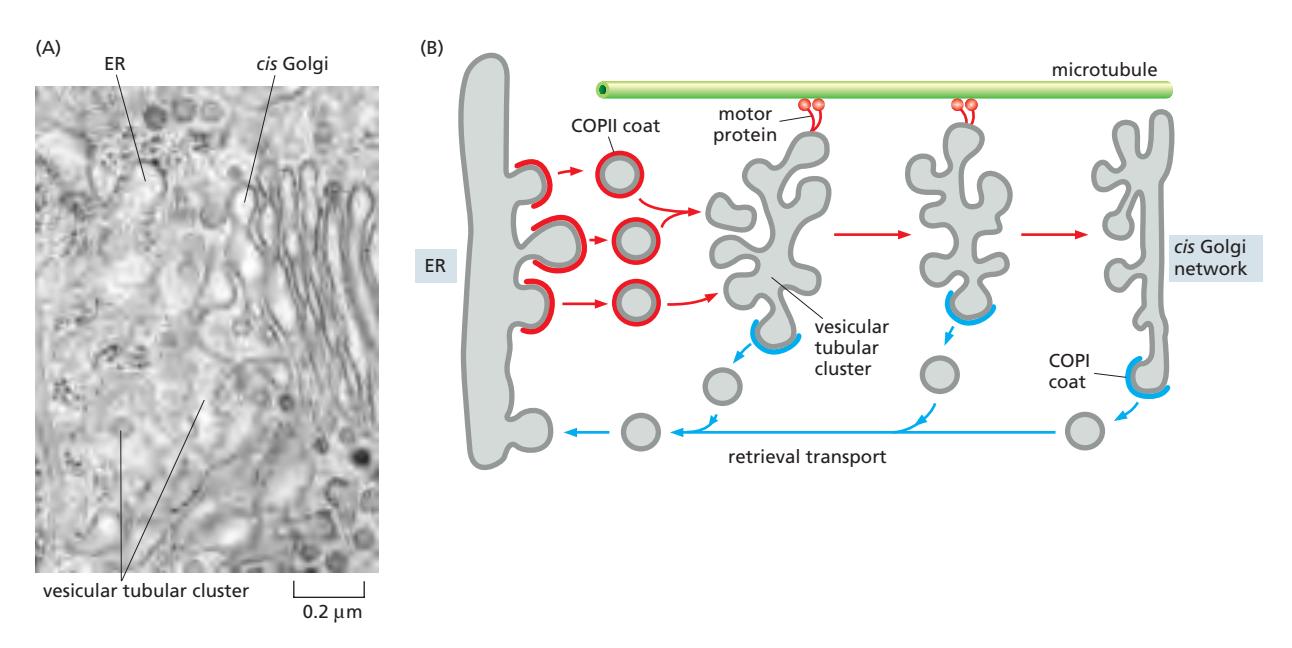
ER-derived transport vesicle이 coat shed 후:
-
Homotypic fusion:
- COPII-coated vesicle이 서로 fusion
- Homotypic fusion은 symmetrical SNARE interaction 사용
- 양쪽 membrane에 v-SNARE와 t-SNARE 모두 존재
-
Vesicular tubular cluster 형성:
- Convoluted appearance (electron microscope)
- ER과는 separate compartment
- ER에서 기능하는 많은 protein 부재
-
Continual generation:
- 지속적으로 생성
- ER에서 Golgi로 material 운반하는 transport container로 기능
Movement to Golgi
Microtubule-based transport:
- Vesicular tubular cluster가 microtubule을 따라 빠르게 이동
- Motor protein에 의해 추진
- Golgi apparatus로 이동하여 fusion
Typical lifetime:
- 약 10분간 incoming vesicle 수용
- 이후 late endosome으로 maturation 시작
Tubular and Vacuolar Domain
Early stage vesicular tubular cluster:
- Tubular domain: 대부분의 membrane surface area
- Vacuolar domain: 대부분의 volume
Retrieval Pathway to the ER
COPI-coated Vesicle Budding
Vesicular tubular cluster 형성 직후:
- COPI-coated vesicle budding 시작
- COPII coat shed된 지 수 초 후
- Coat assembly switch의 조절 mechanism은 아직 불명확
Coatomer
COPI-coated vesicle의 unique feature:
- Inner와 outer coat layer component가 coatomer라는 preassembled complex로 recruit
- Clathrin이나 COPII와 달리 한 번에 recruit
Retrieval Function
COPI-coated vesicle은 retrieval pathway 기능:
Cargo:
-
Escaped ER resident protein:
- 실수로 ER 떠난 protein
- ER retrieval signal로 인식되어 return
-
Recycled machinery component:
- ER budding에 참여한 cargo receptor
- SNARE protein
- 다시 ER로 돌아가 재사용
Continuation:
- Retrieval은 vesicular tubular cluster뿐만 아니라
- Golgi apparatus에서도 계속됨
- Vesicular tubular cluster가 Golgi로 이동하면서도 retrograde transport 지속
Maturation Process
Vesicular tubular cluster는 계속 mature:
- Tubular domain의 대부분이 ER로 recycled
- Vacuolar domain thoroughly modified
- Endosome이 motor에 의해 nucleus 쪽으로 이동
- Composition 지속적으로 변화
- Selected protein이 ER로 return
- Eventually transform into late endosome
Golgi 도달 후에도 retrieval 계속되어 더욱 mature.
ER Retrieval Signal
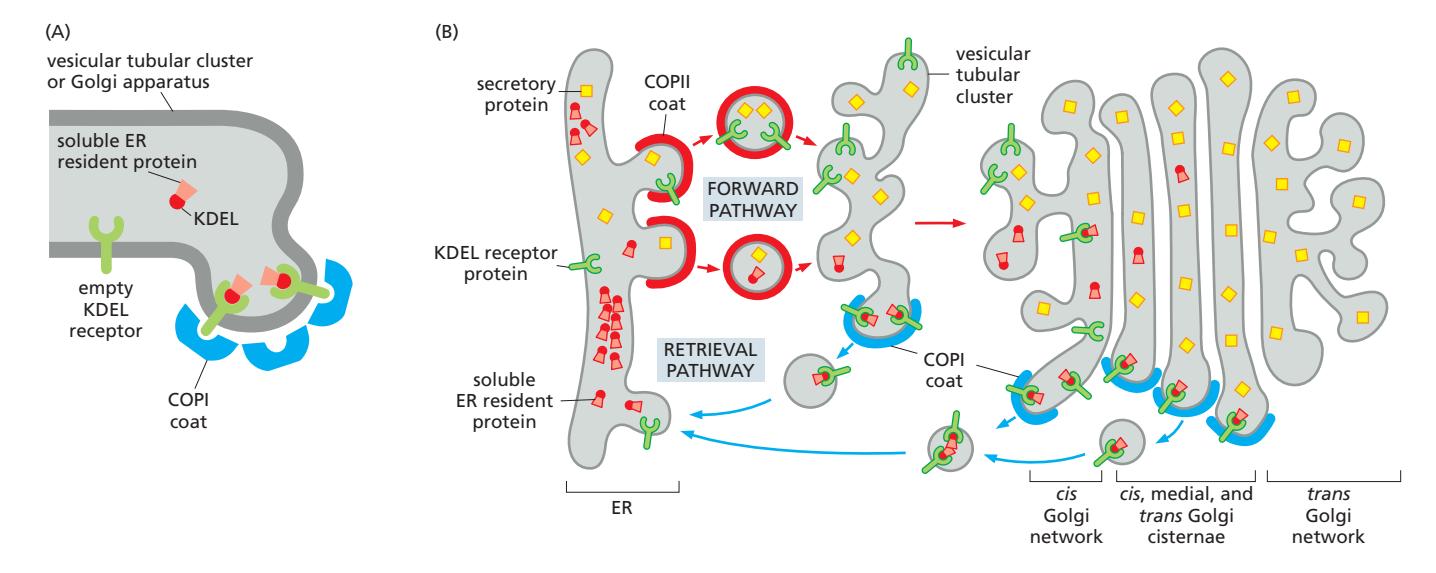
Retrieval pathway는 ER retrieval signal 의존
Membrane Protein의 Retrieval Signal
KKXX sequence:
- C-terminal end에 two lysine + any two amino acid
- Single-letter amino acid code로 KKXX
- COPI coat에 directly bind
- COPI-coated vesicle에 package되어 ER로 retrograde delivery
Function:
- ER membrane protein retain
- ER-Golgi interface에서 기능하는 membrane protein에서 발견:
- v-SNARE와 t-SNARE
- Some cargo receptor
Soluble Protein의 Retrieval Signal
KDEL sequence (Lys-Asp-Glu-Leu):
- C-terminal end
- BiP 같은 soluble ER resident protein에 존재
Genetic engineering experiment:
- KDEL 제거 시: BiP가 천천히 secreted
- KDEL을 normally secreted protein에 transfer: ER accumulation
KDEL Receptor:
- Multipass transmembrane protein
- KDEL sequence 인식
- KDEL-bearing protein을 COPI-coated retrograde vesicle에 package
Receptor Cycling
KDEL receptor cycling:
- ER과 Golgi 사이 shuttle
- Golgi에서 KDEL sequence binding (high affinity at lower pH)
- ER에서 release (low pH에서 affinity 감소)
pH-dependent affinity:
- Golgi의 낮은 pH에서 강한 binding
- ER의 pH에서 weak binding
- Critical histidine이 Golgi의 lower pH에서 protonated
- Protonation이 KDEL sequence와의 interaction favor
V-type ATPase에 의한 H⁺ pump가 이 pH difference 유지.
Similar mechanism:
- 세포의 많은 protein-sorting step에서 pH-sensitive interaction 사용
- Compartment의 pH difference가 directional transport 제공
Retention Mechanism
ER Retrieval Signal의 한계
KDEL 제거된 ER resident protein:
- Secretion되지만 normal secretory protein보다 훨씬 느림
- KDEL pathway가 일부만 설명
Aggregation-based Retention
또 다른 retention mechanism 제안:
- ER resident protein끼리 서로 결합
- Too big complex 형성하여 transport vesicle 진입 비효율적
Rationale:
- ER resident protein은 ER에서 매우 높은 concentration (millimolar 추정)
- Relatively low-affinity interaction으로도 충분
- 대부분의 protein이 complex로 retain
General mechanism:
- 같은 compartment에서 기능하는 protein끼리 aggregation
- Golgi enzyme도 서로 bind
- Transport vesicle에서 restrained
- Organelle에 resident protein organize 및 retain하는 일반 mechanism
Two-tier Retention
결합된 mechanism:
- Primary retention: Protein aggregation
- Backup retrieval: KDEL receptor pathway로 escaped protein capture
이중 체계로 ER resident protein의 effective retention 달성.
관련 내용
- CFTR과 quality control
- ER retrieval mechanism
- Vesicular tubular cluster
- Vesicle formation
- Vesicle fusion
- Golgi apparatus
- ER protein synthesis
Footnotes
-
2021 중간 13번 — COPII coat가 ER에서 Golgi로 단백질을 수송하는 메커니즘이 정답 근거로 활용됨. ↩